Objects, Methods and Historical Beliefs
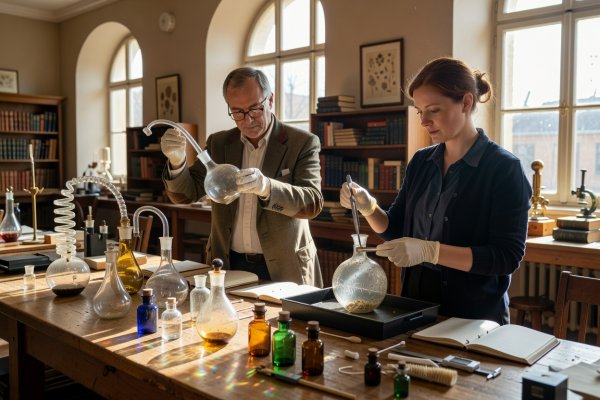
Long before the emergence of clean-room synthetic chemistry, plant extraction was a physical craft. Mortars, copper stills, filtration cloths, and clay jars shaped how historical communities separated plant parts from their raw matrix.
Historical Examination Only
The technologies and mixtures detailed below represent historical artifacts and obsolete beliefs. They are discussed purely for historiographical education and must not be replicated or ingested.
Vessels and Mechanics of Extraction
-
01
Mechanical Comminution
Porphyry and Bronze Mortars
In medieval pharmacies, dry roots and barks were pounded in deep bronze or stone mortars to rupture lignified cell walls before steeping in vinegar, honey, or wine.
-
02
Thermal Evaporation
The Moorish Alembic
The innovation of the condensation head and curved beak enabled early chemists to isolate volatile floral distillates, such as rosewater, setting the stage for Renaissance alchemical quintessences.
-
03
Sweet Preservation
Oxymels, Syrups, and Electuaries
Honey and boiled grape must served as antimicrobial preservatives for bitter herbal pastes, forming thick electuaries designed to keep active botanicals stable through winter months.
-
04
External Application
Cataplasms and Fomentations
Herbs were mashed fresh and folded between linen sheets with barley flour or suet to deliver hot, moist herbal applications directly to infected skin or fractured limbs.
The Doctrine of Signatures
Popularized by Paracelsus and Giambattista della Porta, the Doctrine of Signatures claimed that God marked plants with physical clues indicating their medicinal purpose—e.g., walnut shells resembling the human cranium. While culturally fascinating, modern biology has thoroughly disproven any scientific basis for signature-based morphology.